
The Brief: On 2 November 2026, developer analytics leader LinearB unveiled its 2026 Software Engineering Benchmarks Report and Agentic Studio platform, documenting that heavy AI adoption doubles merged code volume while ballooning pull request sizes by 2.6 times.
Software engineering workflows are undergoing a structural transformation as autonomous agents and generative coding assistants take over routine code production. While individual developers are generating code at historic speeds, traditional delivery pipelines are struggling under the resulting volume.
On 2 November 2026, developer productivity insights platform LinearB launched its Agentic Studio and released findings from its 2026 Software Engineering Benchmarks Report, evaluating 8.1 million pull requests across 4,800 engineering teams in 42 countries. The empirical data confirms that while developers using AI tools on at least 75% of coding days merged 96% more pull requests year-on-year, unassisted colleagues merged 3.6% fewer. However, this production surge masks an emerging operational vulnerability: the volume and complexity of generated code are outpacing human verification.
The Review Bottleneck and Ballooning Workloads
The central challenge highlighted by the benchmark data is not code generation, but integration. According to LinearB's enterprise benchmark analysis, AI-assisted pull requests were 2.6 times larger at the 75th percentile than unassisted submissions.
As PR sizes balloon, human maintainers face severe review fatigue. Rather than accelerating cycle times end-to-end, unmanaged AI adoption risks shifting the delivery bottleneck from authoring logic to peer evaluation. Without structured context and automated quality gates, engineering organisations experience longer wait times before deployment, offsetting the nominal gains achieved at the code-authoring stage.
Autonomous Agents Confront Reality
Beyond developer copilots, fully autonomous coding agents are starting to contribute to enterprise repositories, yet their autonomy remains bounded. LinearB's data shows that at the 90th percentile of adoption, autonomous agents open 4.7% of all pull requests. Furthermore, even within high-performing engineering organisations, AI assists in only 54% of pull requests overall, showing adoption remains far more deliberate than popular discourse implies.
The data also highlights an efficiency disparity between human and synthetic authorship. At elite organisations, 79% of autonomous agent pull requests merge within 30 days, compared to 92% of pull requests authored solely by human engineers. Agents can generate functional syntax rapidly, but they often lack the systemic context necessary to resolve edge cases, documentation standards and architectural consistency without human intervention.
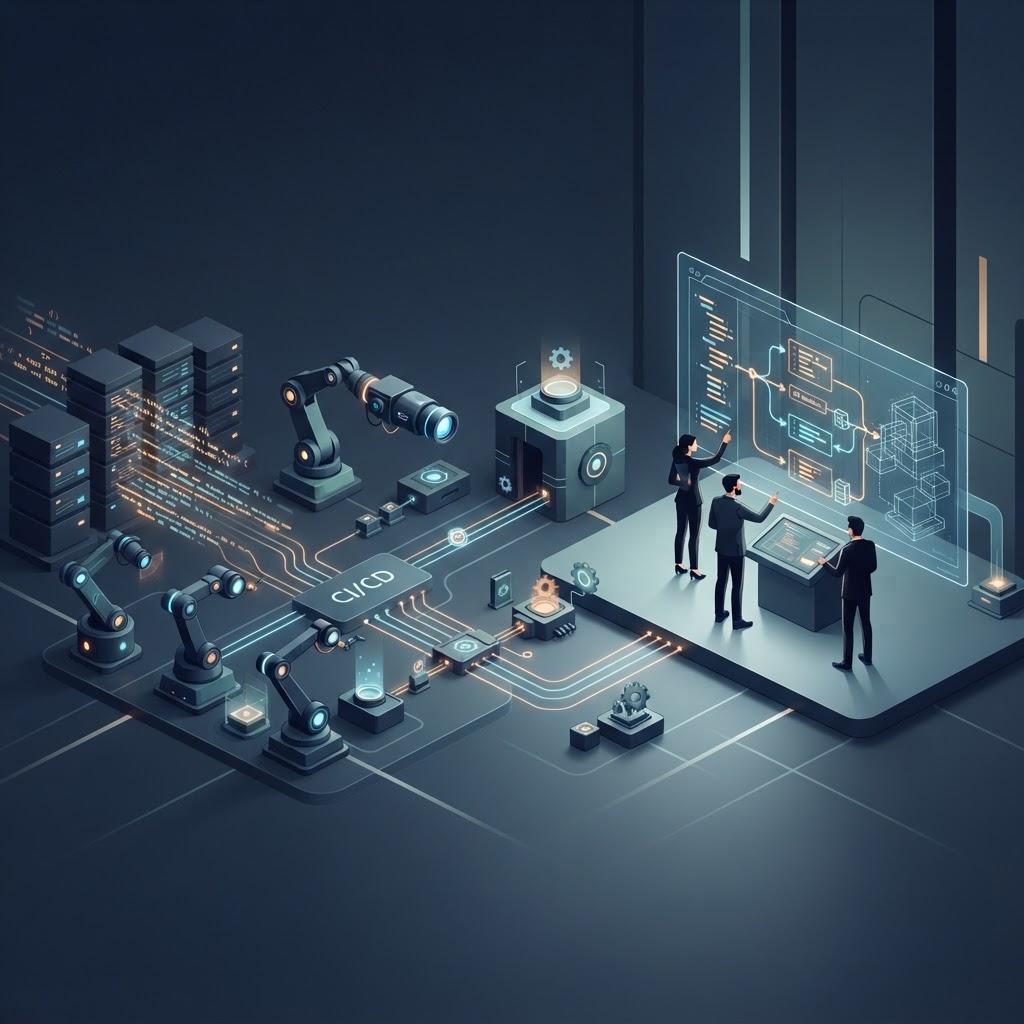
- 01Task decompositionBreak user stories into isolated functional specifications
- 02Context injectionProvide repository architecture rules and boundary conditions to the agent
- 03Automated gatekeepingExecute static analysis, security scans and integration tests on agent branches
- 04Architectural signoffHuman maintainers inspect design consistency, logic cohesion and telemetry
Illustrative design pattern, not a vendor architecture.
Redefining Engineering Roles and the Entry Level
The expansion of machine-authored code is fundamentally shifting engineering talent requirements. Industry analysis from IT leadership surveys indicates that integrating AI into development pipelines is cited by 57% of organisations as their primary software challenge, with 48% highlighting heightened security and privacy risks. Because autonomous agents execute tasks rapidly, errors propagate much faster than traditional verification workflows were designed to catch.
This velocity is reshaping technical careers, particularly for early-career developers. Mid-tier IT services firms and large systems integrators are actively restructuring roles away from traditional, entry-level syntax implementation toward AI-assisted architecture and systems orchestration. As routine coding becomes automated, junior practitioners must master prompt specifications, pull-request auditing, pipeline instrumentation and security validation earlier in their careers to remain competitive.
Context Engineering Over Raw Syntax
To bridge the gap between autonomous code generation and human maintainability, developer tooling is evolving to provide context directly to agents. LinearB's newly announced Agentic Studio normalises telemetry across Git repositories, issue trackers and deployment workflows, translating project-level context into actionable guidance for both human engineers and AI agents.
This architectural shift points toward context engineering as a decisive discipline. The bottleneck in software delivery is no longer typing speed or syntax recall, but providing autonomous systems with precise business constraints and strict architectural guardrails. Teams that establish automated feedback loops and granular context boundaries will scale successfully, while those relying on unchecked prompt generation will face unsustainable review backlogs.
Practical Takeaway for Technology Teams
Organisations should implement automated branch policies that enforce strict size thresholds on AI-generated pull requests. Mandating that autonomous agents and AI-assisted contributors submit smaller, single-responsibility changes backed by automated unit tests directly mitigates review fatigue and keeps merge cycles manageable.