The Brief
On 20 October 2026, Salesforce signed a definitive agreement to acquire customer engagement platform Braze for approximately $5.66 billion in enterprise value. The acquisition directly integrates Braze's real-time streaming and AI decisioning engine into Salesforce's Data 360 and Agentforce architectures, marking a pivotal shift towards event-driven autonomous customer interactions.
The Strategic Move Behind the $5.66 Billion Acquisition
Salesforce announced on 20 October 2026 that it has entered into a definitive transaction to acquire customer engagement platform Braze (NASDAQ: BRZE) for an enterprise value of approximately $5.66 billion. Under the terms of the agreement, Braze Class A common stock holders will receive $47.50 per share in cash. The transaction directly targets the growing operational divide between enterprise data warehouses, customer relationship records, and instant messaging channels.
According to Salesforce leadership, the acquisition will fortify all core layers of its platform: Data 360, Customer 360, and the newly expanded Agentforce autonomous layer. Braze brings proven infrastructure for high-throughput, cross-channel messaging across mobile push, in-app interactions, email, and SMS. By incorporating Braze's low-latency streaming pipeline, Salesforce aims to eliminate batch-oriented processing delays that often limit AI responsiveness.
This consolidation reflects an urgent enterprise need for real-time data activation. While foundational CRM platforms excel at maintaining structured systems of record, autonomous AI agents require instant streaming events to trigger meaningful contextual actions without waiting for scheduled pipeline synchronisations.
Solving the Latency Bottleneck for Autonomous Agents
Modern customer-facing deployments are experiencing an influx of complex queries driven by automated personal assistants. In executive commentary published on 19 October 2026, Salesforce Service Cloud leadership noted that consumer AI agents increasingly initiate customer service requests on web platforms and APIs, requiring enterprise systems to complete transactions with deep contextual awareness rather than simple scripted answers.
When external or internal agents attempt to interact with enterprise systems, they frequently encounter delays and stale data points. Braze’s event-driven architecture processes consumer signals as they occur, evaluating rules and AI models in milliseconds. Embedding this capability natively into the Agentforce execution layer ensures subagents can act upon live customer behaviour immediately.
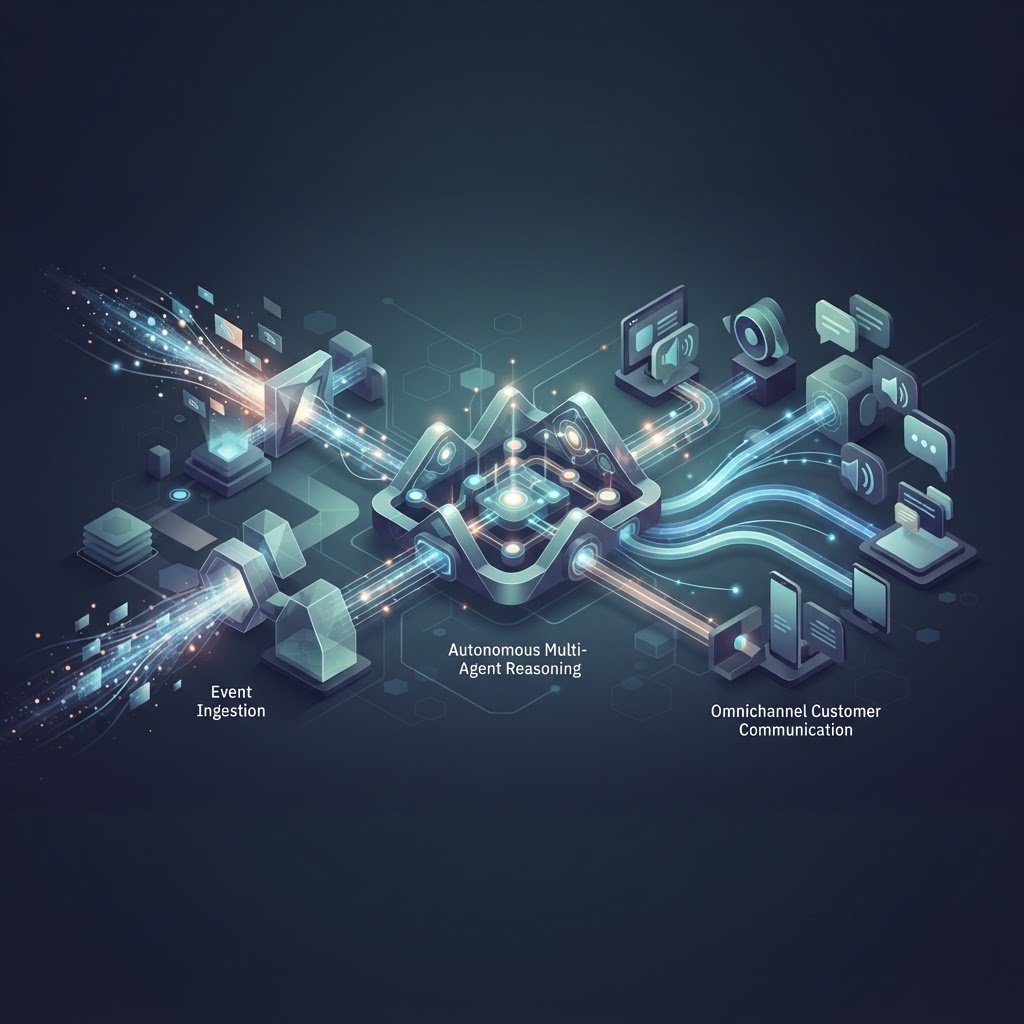
- 01Event IngestionBraze streams real-time customer behavioural events into Data 360
- 02Context EvaluationAgentforce resolves customer history and permissions across Customer 360
- 03Action OrchestrationMulti-agent coordination assigns the task to specialised subagents
- 04Omnichannel DispatchBraze infrastructure delivers low-latency notifications across live mobile and web channels
Illustrative design pattern, not a vendor architecture.
This continuous loop bridges the gap between passive CRM storage and real-time execution. In our analysis, enterprises will increasingly measure CRM success by latency metrics, assessing how quickly an autonomous agent detects customer friction and coordinates an automated resolution.
Architectural Synergy Across Data 360 and Subagents
To understand the technical value of the acquisition, engineering and architecture teams must look at how Salesforce has evolved its core AI framework. Official developer documentation confirms that Salesforce transition agent topics into subagents, providing granular, modular control over multi-agent workflows.
Integrating Braze introduces a unified streaming bus that connects these specialised subagents directly to external consumer touchpoints. Instead of relying solely on API polling or standard webhooks, Agentforce can register event listeners directly within Braze’s interaction layer. This integration eliminates intermediate translation middleware and reduces brittle custom integrations.
| Architecture Layer | Core Technology | Primary Functional Role |
|---|---|---|
| System of Record | Salesforce Customer 360 | Governs master customer profiles, case histories, and permission models |
| Streaming Ingestion | Braze Real-Time Engine | Captures millisecond behavioural telemetry across mobile, web, and messaging |
| Agentic Execution | Agentforce Subagents | Deploys specialized reasoning and executes programmatic tasks based on live signals |
| Data Unification | Salesforce Data 360 | Harmonises disparate enterprise datasets to supply context to AI models |
This architectural convergence establishes a cohesive loop. High-velocity consumer inputs stream through Braze, are validated against permissions in Customer 360, and prompt immediate workflow resolution through Agentforce subagents.
Career Implications for CRM Administrators and Analysts
The absorption of Braze into Salesforce carries profound consequences for technical career pathways. Traditional marketing operations and CRM administration roles have historically operated in organisational silos, using distinct toolsets and separate reporting lines. The unification of real-time lifecycle engagement and automated CRM reasoning will accelerate the merger of these disciplines.
Professionals holding credentials such as the Salesforce Certified Agentforce Specialist or Marketing Cloud certifications will need to develop hybrid capabilities. Practitioners must move beyond static journey builders to master event triggers, state management, and real-time token constraints. Understanding how autonomous subagents consume live event streams will be an essential prerequisite for solution design.
Business analysts must also adapt their requirements-gathering approaches. Instead of defining step-by-step sequential workflows, technical analysts will design guardrails, business intent frameworks, and fallback conditions for autonomous subagents responding to real-time events.
Practical Takeaway and Preparation
Enterprise architects and CRM practitioners should review their current event streaming pipelines and evaluate where batch sync processes cause operational lag. A practical first step is to audit your organisation's existing integration points between customer engagement tools and the CRM core. Developing hands-on competency in event-driven architecture, Data 360 ingestion mechanics, and Agentforce subagent orchestration will provide a durable competitive edge as real-time autonomous systems become standard enterprise infrastructure.