

The Brief
On 26 October 2026, Oracle unveiled major updates to its Autonomous AI Lakehouse, introducing a business semantic layer, an intelligent AI Data Catalog, and agentic pruning. The development allows autonomous agents to execute complex enterprise workflows across fragmented data stores without costly data replication.
Grounding Enterprise Agents in Live Operational Context
Deploying autonomous agents within enterprise environments frequently exposes a fundamental weakness: foundation models struggle to interpret raw database schemas without contextual business logic. When agents execute queries across uncurated data lakes, they frequently hallucinate relationship links, misunderstand column definitions, and trigger inaccurate operational actions.
To bridge this divide, Oracle introduced major capabilities for its Autonomous AI Lakehouse on 26 October 2026 at Oracle AI World. The release embeds a business semantic layer directly on top of open Apache Iceberg storage and relational estates, letting multi-agent systems query live transactional structures without moving data into isolated stores.
By moving the reasoning layer closer to operational storage, organisations bypass fragile Extract, Transform, Load (ETL) pipelines. Autonomous workflows can now interpret critical business dimensions, such as customer lifetime value or regional compliance boundaries, using uniform metadata rules.
The Shift Toward Semantic Catalogs and Agentic Pruning
A critical technical bottleneck in multi-agent orchestration has been context window saturation caused by massive database schemas. When an autonomous agent attempts to locate relevant tables across thousands of endpoints, processing raw metadata drains compute budgets and introduces latency.
According to technical architecture documentation from Oracle Database Product Development, the new AI Data Catalog deploys agentic search and agentic pruning. This mechanism dynamically filters metadata schemas down to the most relevant assets before passing context to orchestrators, improving response accuracy while restricting token expenditure.
Furthermore, the system continuously tracks query patterns and business lineage to enrich metadata definitions autonomously over time. Instead of relying on data engineering teams to manually map every semantic relationship, background agents index schema modifications and keep operational representations aligned with running software.
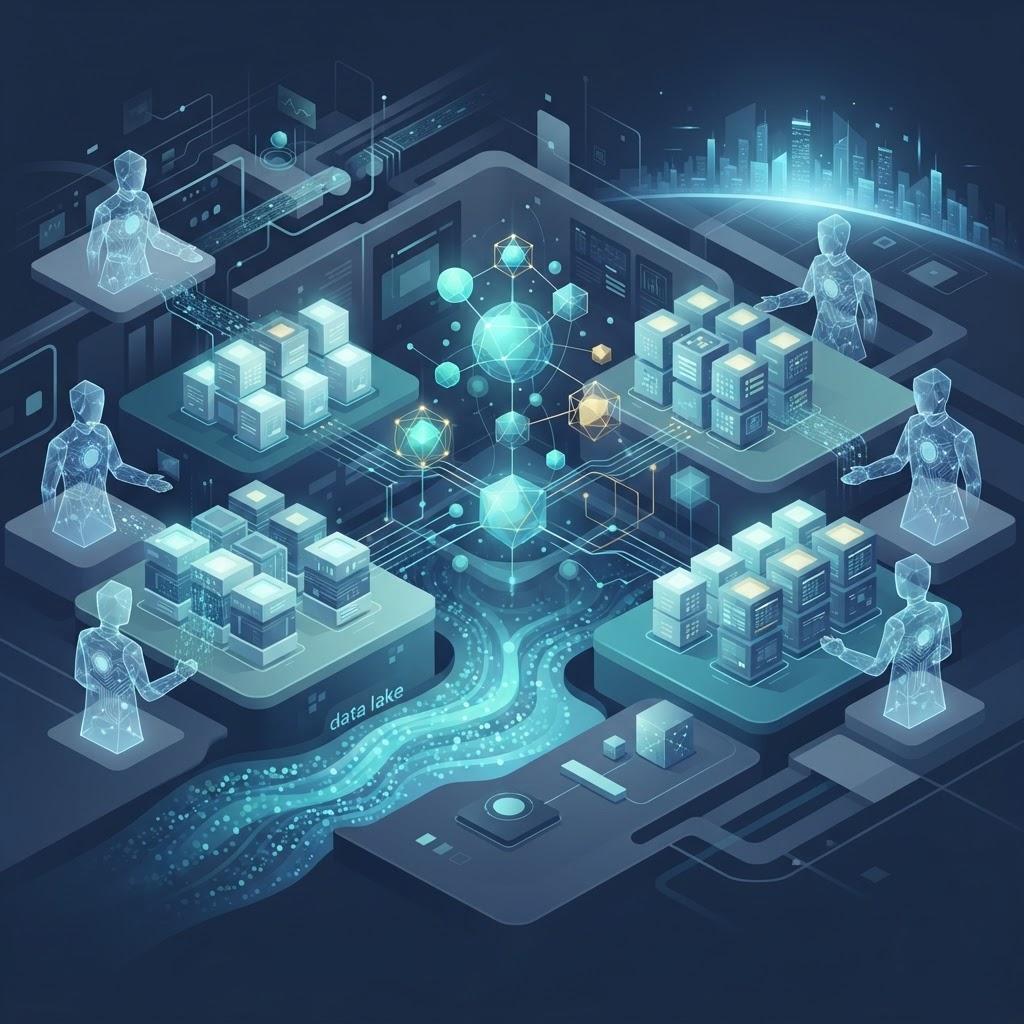
- 01Schema DiscoveryAn autonomous agent requests enterprise financial or operational context across lakehouse endpoints.
- 02Semantic MappingThe AI Data Catalog applies business metadata and Iceberg mappings, identifying governing constraints.
- 03Agentic PruningThe catalog trims irrelevant tables and fields, emitting a condensed context payload to the orchestrator.
- 04Deterministic ExecutionThe agent executes multidimensional queries or simulations under uniform access controls without data replication.
Illustrative design pattern, not a vendor architecture.
Reinforcing External Access Governance for Autonomous Workflows
Granting agents direct database interfaces introduces severe security risks if permission checks rely purely on model alignment. Industry frameworks highlight that generative models cannot serve as their own security boundary when executing data manipulation commands.
Security architecture research on AI agent access control models and permissions demonstrates that authorization policies must remain deterministic and reside in software layers outside the language model. Oracle's lakehouse architecture enforces this separation by binding autonomous agents to unified enterprise security protocols, ensuring that an agent operating without a human in the loop inherits strict role-based and attribute-based constraints.
This design prevents prompt injection vulnerabilities from overriding core database privileges. If a rogue prompt commands an agent to drop financial partitions or exfiltrate private records, complete mediation at the catalog layer denies the request regardless of model intent.
Strategic Implications for Technology Roles
The consolidation of business semantics into database runtimes alters functional responsibilities across multiple enterprise teams. The operational boundaries between analytics, governance, and autonomous engineering are actively converging.
| Functional Role | Previous Workflow | Lakehouse Agentic Workflow |
|---|---|---|
| Data Engineers | Writing custom ETL pipelines to feed analytical vector stores | Curating open Iceberg tables and managing semantic catalog definitions |
| AI & Software Engineers | Hardcoding schema definitions into model prompts and system cards | Pointing autonomous orchestrators to unified semantic APIs with automated pruning |
| Business Analysts | Manually extracting CSVs and reconciling cross-department metrics | Defining metric calculation rules inside semantic layers for autonomous agent retrieval |
For systems engineers and platform teams, maintaining semantic health becomes as vital as tracking cluster uptime. When autonomous workers depend on enterprise catalogs to make decisions, corrupt or ambiguous definitions cascade directly into automated business failures.
Practical Steps for Data and AI Practitioners
Enterprise architects should audit existing agent prototypes to ensure they do not query raw operational schemas directly. Relying on agents to guess column meanings from unstructured table names invites silent failure modes that human reviewers struggle to detect.
Data and analytics professionals should begin standardising metric definitions within centralized semantic models rather than embedding formulas in prompt templates. Establishing uniform business rules within open data formats guarantees that whether a query originates from a human analyst or an autonomous worker, the resulting insight remains mathematically sound.