
The Brief: Infrastructure automation faces a structural shift as autonomous agent workloads multiply API calls and job fan-outs across production Kubernetes clusters.
Platform engineering teams are confronting a fundamental operational change in how cloud-native infrastructure processes automated requests. On 16 October 2026, technology infrastructure analysts highlighted in The New Stack that emerging agentic frameworks systematically expand single developer inputs into approximately 20 autonomous execution calls. As autonomous agents move beyond advisory roles into direct execution across containerised environments, standard continuous integration and orchestration setups face severe concurrency and resource contention.
This dramatic amplification of internal traffic alters how platform teams design operational pipelines and enforce reliability standards. Traditional continuous integration and continuous delivery (CI/CD) pipelines were calibrated for predictable developer commits and periodic batch jobs. The rise of multi-step autonomous processes demands that platform teams construct adaptive runtime controls and specialised orchestration planes capable of absorbing massive task expansion without degrading core services.
The Fan-Out Dilemma in Modern Clusters
When a human software engineer initiates a deployment, the operational sequence is generally linear: code is packaged, unit tests execute, artifacts are validated, and deployment manifests apply sequentially. In contrast, autonomous operational agents decompose single user goals into expansive diagnostic and remediation loops. A single remediation command can spawn parallel container evaluations, metric inspections, log aggregations, and transient ephemeral test runs across dozens of namespaces.
This multiplier effect alters the compute and networking assumptions behind Kubernetes cluster management. Control planes experience concentrated bursts of API queries, while ephemeral worker nodes experience sudden autoscaling pressure. If uncontained, agent-driven background activity can exhaust cluster quotas, trigger cascading rate limits from cloud infrastructure providers, and starve critical customer-facing microservices.
- 01Trigger ingestionSingle agent prompt arrives requesting automated remediation or environment provisioning.
- 02Task decompositionOrchestrator breaks high-level instruction into parallel diagnostic queries and container jobs.
- 03Dynamic schedulingWorkload controller enforces rate limits, execution timeouts, and ephemeral pod lifecycles.
- 04Automated verificationPlatform monitors runtime drift and records execution provenance before committing state changes.
Illustrative design pattern, not a vendor architecture.
Rethinking CI/CD and Delivery Infrastructure
To accommodate these demands, platform engineering workflows are shifting from static delivery pipelines to continuous reconciliation engines. Conventional automation architectures, as detailed in recent industry guides on modern continuous integration across Northflank's CI/CD Architecture Review, emphasize pipeline gates that halt execution upon explicit failure. However, autonomous agents actively attempt alternate pathways when encountering blocked steps, creating unpredictably long execution tails.
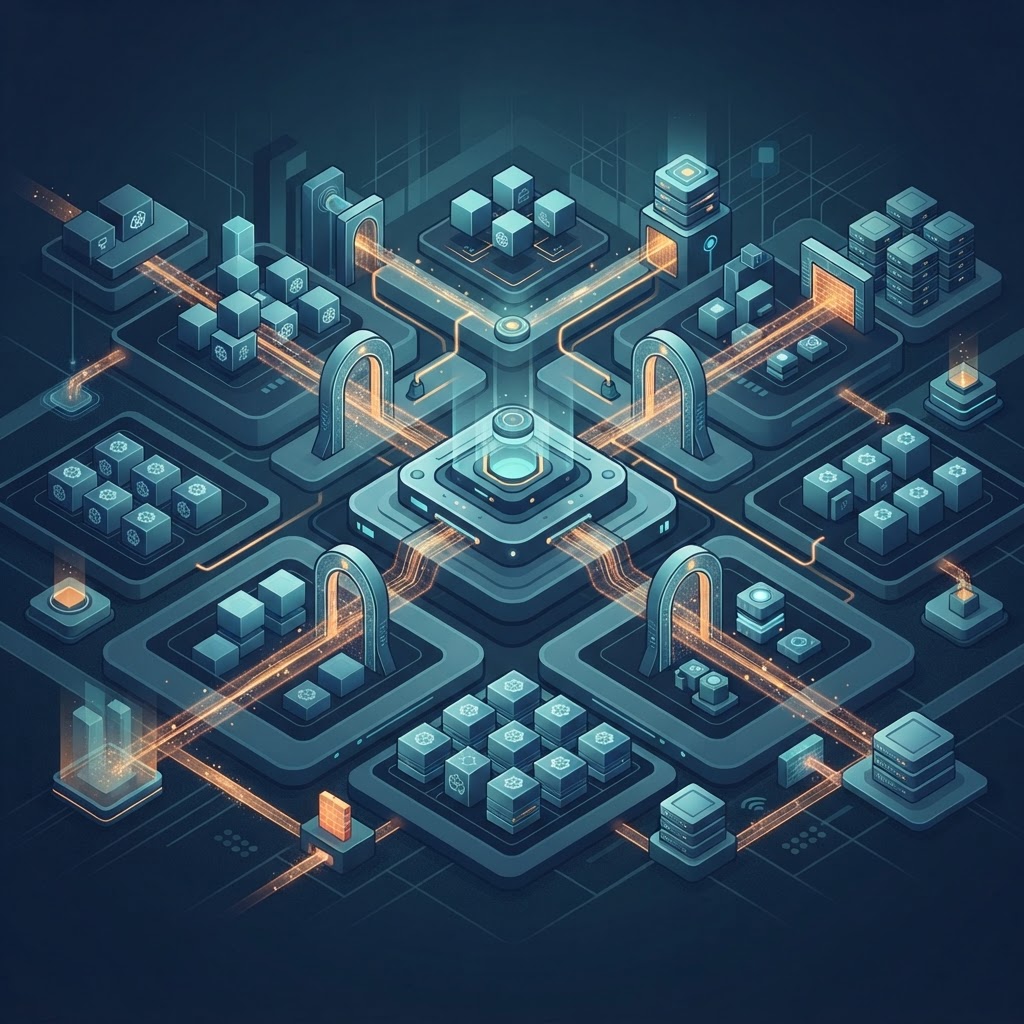
Consequently, organisations are deploying internal developer platforms that pair policy governance with isolated runtime envelopes. Rather than granting agents direct access to root-level cluster credentials, platform engineers introduce intermediate control layers. These proxies inspect agent intent, deduplicate repetitive operational queries, and enforce strict execution budgets before requests touch cloud resources.
Governance and Operational Accountability
As infrastructure automation accelerates, operational oversight emerges as the primary constraint on enterprise adoption. Technical publications examining autonomous systems, including DEVOPSdigest's Architecture Insights, observe that while system telemetry easily captures raw resource metrics, attributing autonomous multi-step tasks to specific business initiatives remains a profound challenge.
| Operational Capability | Traditional CI/CD Pipelines | Agentic Cloud Automation |
|---|---|---|
| Request Multiplier | 1:1 deterministic pipeline executions | 1:20 fan-out of autonomous sub-tasks |
| Runtime Lifecycle | Static runners with scheduled teardown | Highly dynamic, ephemeral burst containers |
| State Verification | Pre-defined integration test suites | Real-time observability and drift mitigation |
| Access Model | Static credentials and RBAC roles | Scoped, short-lived delegated tokens |
Platform teams must introduce verifiable audit logging that records not only what code was deployed, but precisely which agent reasoning chain authorized the cluster modification. Without rigorous traceability, debugging distributed failures becomes unmanageable when multiple semi-autonomous tools interact within the same cluster ecosystem.
Practical Implications and Strategic Takeaways
For platform engineers, cloud practitioners, and DevOps specialists, the priority must shift from basic script writing to architecting secure, throttled execution environments. Understanding Kubernetes primitives, Custom Resource Definitions (CRDs), and admission controllers is now essential for managing agentic workloads safely. Engineering teams cannot simply plug autonomous tools into existing deployment pipelines without establishing guardrails that limit fan-out loops.
Platform leaders should immediately audit existing internal pipelines for agent compatibility. Establish dedicated node pools with aggressive autoscaling dampeners, enforce strict API rate limiting on internal automation services, and require verifiable provenance logging for every non-human cluster action.