The Brief
As enterprise code repositories cross a critical threshold of automated generation, technical organisations are facing an operational reckoning. Sourced data shows that while code creation velocity has expanded, testing, human code review, and inference economics are emerging as primary structural constraints.
The Automation Threshold in Production Systems
Recent empirical operational data reveals that artificial intelligence assistance in enterprise software development has reached an institutional tipping point. According to data published on 2 November 2026 in the Q3 2026 Engineering AI Impact Report by Larridin, AI-assisted pull requests inside tracked engineering organisations grew from 35% in April to 62% by September 2026. This data, drawn from the telemetry of over two billion enterprise sessions, demonstrates that code generation is no longer an experimental assist but the dominant origin of pull requests in mature environments.
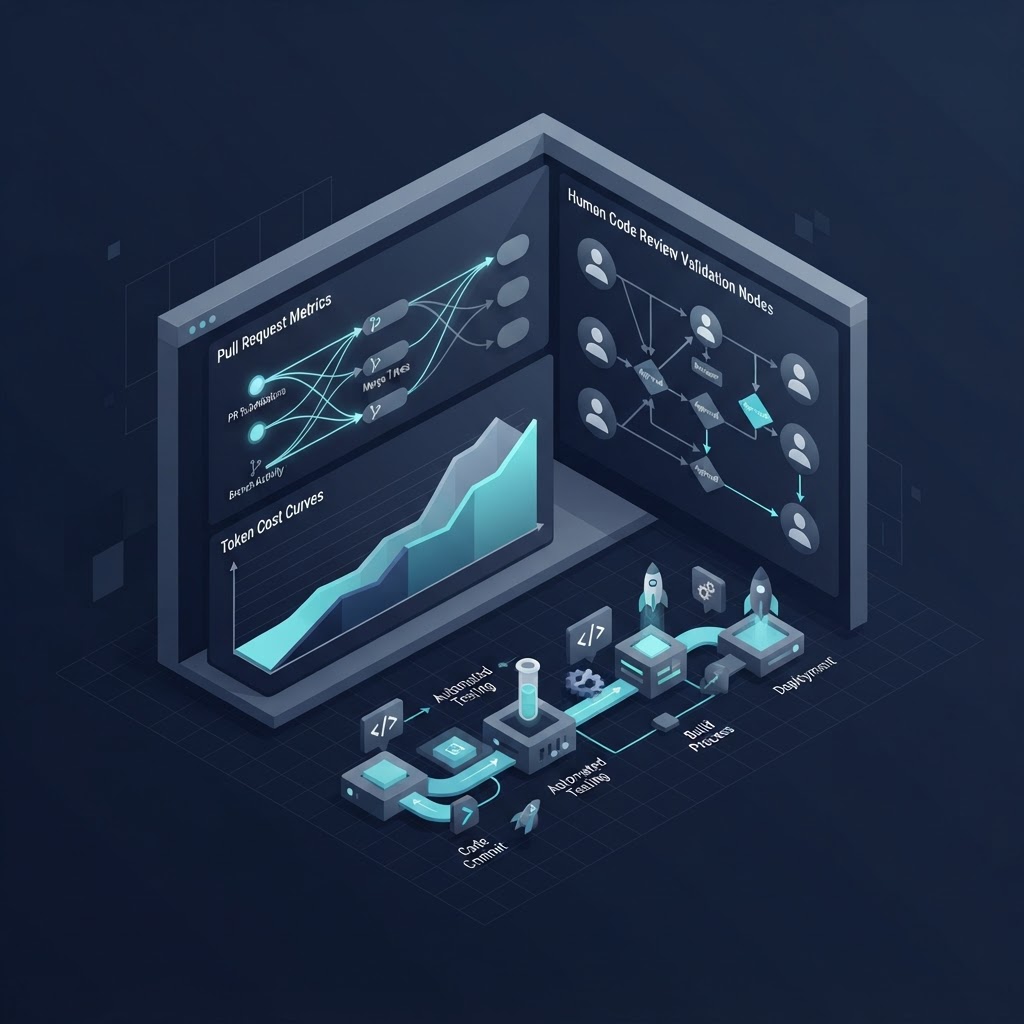
While generation speed has surged, the downstream development pipeline has absorbed unprecedented friction. Sourced enterprise telemetry indicates that higher code output has introduced severe review pressure, as human engineers spend disproportionate time validating machine-written diffs and synthetic branch logic. The bottleneck of enterprise engineering has consequently relocated from authoring syntax to verifying system integrity and evaluating pull request quality.
Widening Disparities in Inference Unit Economics
The economic viability of automated engineering is also under intense scrutiny as organisations quantify their cloud model expenditures. Detailed pipeline telemetry highlighted in reporting on enterprise AI measurement platforms documented up to a 66-fold cost divergence per shipped engineering change between competing commercial tools performing equivalent development tasks. Unmonitored token utilisation, repetitive context loading, and unchecked speculative agent loops have created vast budget variances that traditional IT procurement frameworks cannot reconcile.
To address this volatility, enterprise engineering teams are formalising FinOps practices directly within continuous integration pipelines. Technical architects are replacing unmetered developer tool access with automated gateway quotas that evaluate cost per unit of accepted production logic. In our analysis, engineering departments that fail to monitor these cost dynamics risk subsidising inefficient context generation without realising genuine operational return.
Human Code Review as the Critical System Constraint
With autonomous code creation accelerating, quality assurance architectures are experiencing structural strain. In parallel findings from Deloitte's enterprise AI study, 81% of surveyed executives noted improvements in operational speed, but only 25% reported deep business transformation, with 40% allowing autonomous execution to run with minimal human sign-off. As automated pull requests increase, the human cognitive load required to detect subtle logical regressions, architectural drift, and security vulnerabilities has grown sharply.
Engineering leadership is learning that more code does not inherently equate to more product delivery. When developer throughput is measured strictly by pull request volume rather than stable releases, engineering teams accumulate silent maintenance debt. This development is driving a redefinition of senior engineering responsibilities away from routine coding and towards rigorous specification design, continuous verification, and system boundary governance.
Pipeline Governance and Architectural Adaptations
To manage both the review volume and disparate compute costs, technology organisations are deploying structured governance stages across their deployment lifecycles. Rather than allowing raw machine output to route directly to human reviewers, engineering pipelines are being redesigned to incorporate automated triage and cost policy thresholds.
- 01Telemetry captureIngest model token usage, tool invocation frequency, and branch metadata directly at the pull request boundary.
- 02Syntactic and cost triageEvaluate automated pull requests against automated test suites and model token budgets before human assignment.
- 03Human architectural reviewSenior engineers audit context boundaries, business invariants, and system trade-offs rather than boilerplate syntax.
- 04Production economics auditingReconcile cloud inference spend against merged feature value to identify model inefficiencies.
Illustrative design pattern, not a vendor architecture.
Strategic Takeaways for Technology Careers
This structural pivot carries profound implications for practitioners across software engineering, DevOps, data analytics, and cloud computing. The industry is moving rapidly past the era of novelty adoption towards strict financial accountability and verified software delivery. The most valuable technology professionals are no longer those who generate the largest volume of syntax, but those who can architect reliable delivery pipelines, evaluate model unit economics, and protect core codebases from unvetted architectural drift.
For career changers and established technologists alike, the immediate priority is to cultivate depth in system design, integration testing, and FinOps metrics. Understanding how to manage autonomous systems within strict cost envelopes and governance boundaries will distinguish sustainable engineering leaders from mere operators as AI-native codebases become the industry baseline.